Sold · found a home
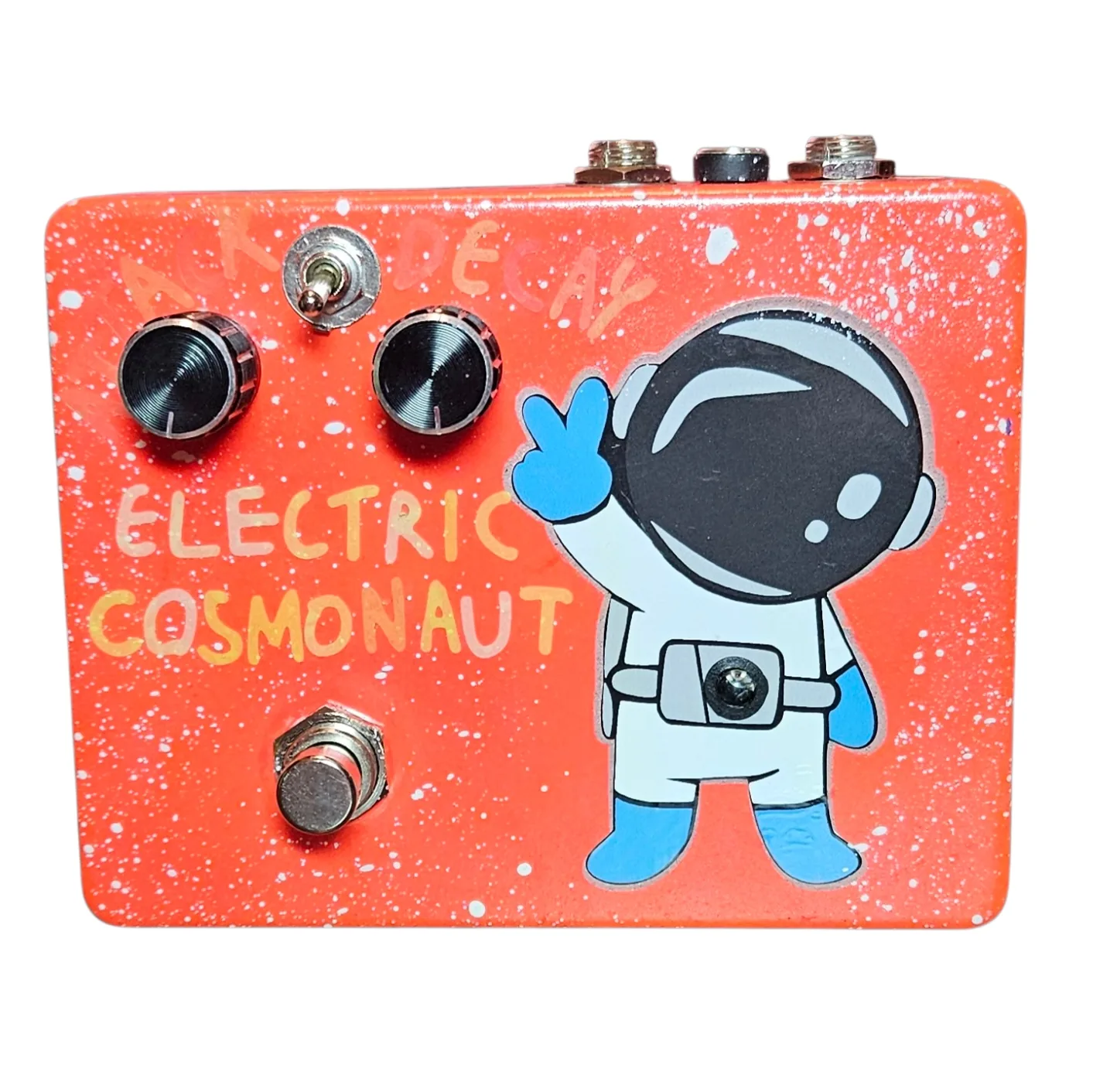
Envelope Filter · One-off prototype
Electric Cosmonaut
Envelope filters are secretly my favorite thing to build. This is PedalPCB's Duck Box: a proper quacky, funky auto-wah that plays itself off how hard you hit the string. Attack and Decay shape the sweep; the Blend toggle lets you keep some clean signal alongside the filtered one. Painted starfield orange with a cartoon cosmonaut on the front because that's what it sounds like in my head. Especially good on bass, and a great weird bloom-maker in front of a fuzz.
- TypeEnvelope filter (dynamic auto-wah)
- ControlsAttack, Decay, Blend toggle
- CircuitPedalPCB Duck Box Filter
- Enclosure125B
- Weight~8 oz
- Power9V DC, center-negative
- BuiltNov 2024
- ConditionBench-tested & fully working
- StatusSold - found a home
What it does
The Electric Cosmonaut is an envelope filter - a filter that sweeps in response to how hard you play instead of a treadle under your foot. Pick softly and it stays mellow; hit it hard and the filter snaps open into that classic funky, quacky, talk-box-adjacent voice. It's the sound of “wakka-wakka” funk rhythm, squelchy synth-bass lines, and cosmic bloops.
Like most envelope filters, it likes a healthy, hot signal to really engage - roll your guitar volume up and dig in to find the sweet spot. It gets genuinely unhinged in front of a fuzz: stack it before a Big Muff and you get glitchy, gated textures and near-infinite sustain that blooms as the filter opens. The controls are hand-engraved right into the enclosure - Attack and Decay on the knobs, Blend above the toggle - so the one-off is as much object as instrument.
Demo
Demo filmed by Onion Madder on the actual unit.
Controls
- Attack
- Sets how quickly the filter reacts to your picking - snappy and immediate at one end, slower and more vocal as you back it off.
- Decay
- Controls how long the sweep hangs on before the filter closes back down - short and stuttery, or long, swelling, and vowel-like.
- Blend (toggle)
- Flips how much dry signal sits underneath the effect - keep the low-end body and punch, or go full-wet for the most pronounced quack.
What builders say about the Duck Box
Heads up: these are verified-owner reviews of the PedalPCB Duck Box Filter - the circuit this pedal is built on - collected from PedalPCB's product page. They're here to show how the design behaves and sounds, not as reviews of this specific hand-built unit.
“Very aptly named; it quacks like a damn duck!! Like most envelope effects, you need a second or two to dial it in depending on how hot your pickups are. Very easy build and sounds fantastic. I used the 4148 diode that is suggested as an alternative in the build doc. Works great.”
“Great pedal, especially with fuzz. I used a 4148 and it sounds great.”
“It seems to want a pretty hot signal before it'll quack even at its most sensitive. I like keeping my volume not maxed and use vintage-style pickups so it might just not be compatible with my setup.”
“You've gotta be playing pretty hard or the signal has to be pretty hot before it seems to ‘engage’. The build was great - easy, plenty of room for pots and switches and fits into the standard 3-hole enclosure.”
“Way better than expected. Sounds immense before a Big Muff, adds tons of cool glitchy textures and infinite sustain. Love it.”
Circuit design: PedalPCB Duck Box Filter. Enclosure art, build, and finish by Onion Madder. Reviews © their respective authors, via PedalPCB. “Duck Box” and “PedalPCB” are used for identification only and imply no endorsement.