Circuit-bent toy keyboard · One of a kind
Super Sound Warps
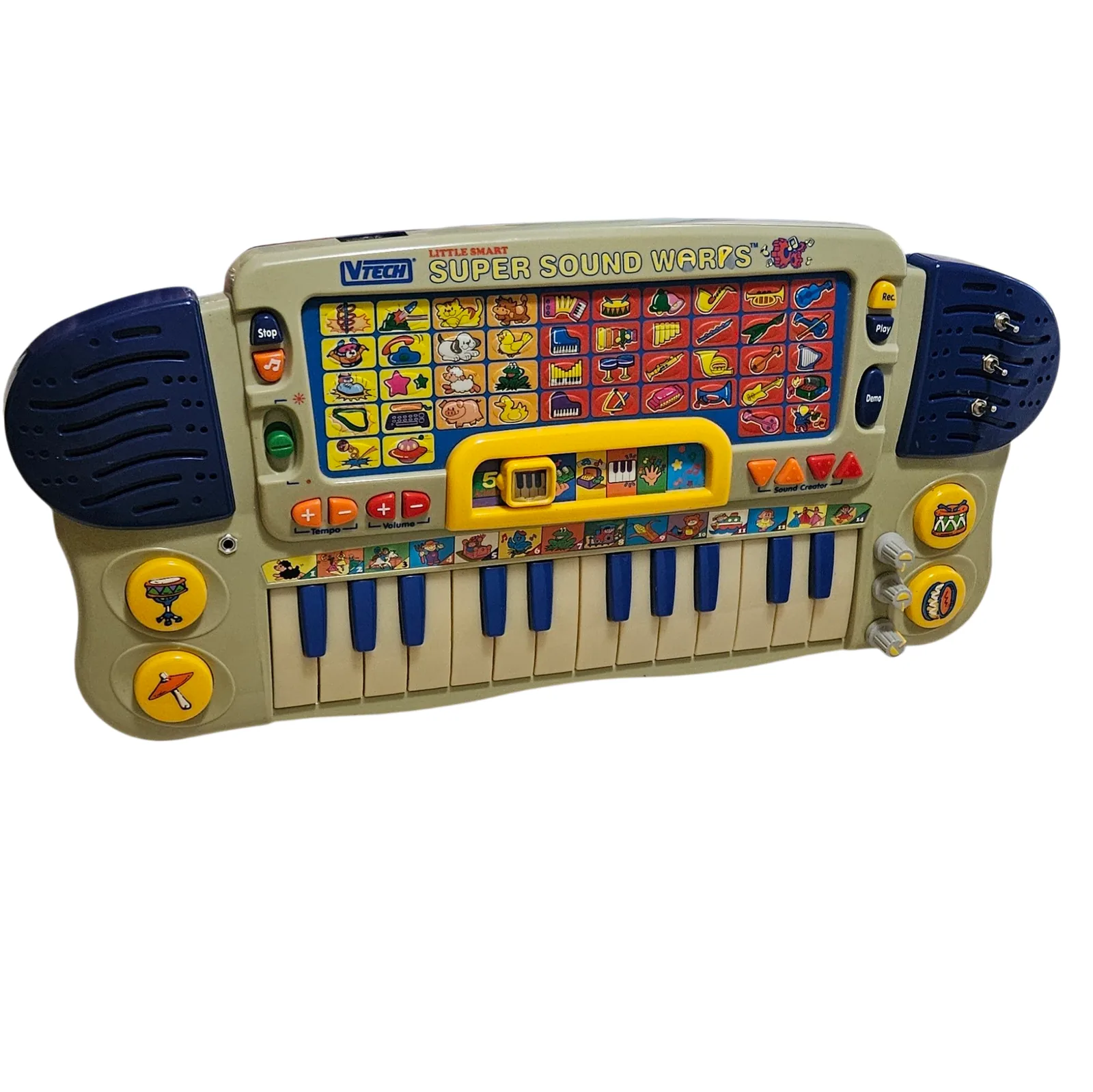
A 1996 VTech toy keyboard with its clock torn out and put on switches. The toy runs off a single crystal and everything it does comes from that one part, so swapping it does not retune the keyboard, it makes the whole thing run fast or slow. There are four crystals in there now and three switches to pick between them, and one of the four is the original, so the toy it used to be is still one of the settings.
- TypeCircuit-bent toy keyboard with a built-in echo
- BaseVTech Little Smart Super Sound Works, 1996
- ClockFour crystals on three toggles – one picks the bank, one picks within each bank
- EchoCD2399 module with depth, feedback and mix on panel knobs. On the line out only
- OutputThe toy's own speakers dry, or a switched 3.5 mm line out with the echo on it – plug in and the speakers cut
- HostFully working. Every voice, drum pad, rhythm, record and playback
- Power4× AA
- StatusOne of a kind. When it is gone it is gone
The clock is the instrument
A toy like this generates everything from one crystal: the pitch of every voice, the speed of every rhythm, the rate its recorded sounds play back. That is why swapping the crystal is a much bigger change than a pitch knob on an oscillator. It is not a tuning control. The whole toy runs at a different speed, and everything moves together.
There are four crystals in it and three toggles to choose between them. The middle switch picks a bank, high or low, and then one switch chooses between the two in whichever bank you are in. Two of those four are fast, two are slow, and one of them is the crystal the toy came with.
The usual way to do this is a chip that gives you a knob and a continuous sweep. I used crystals instead, and having built it I would do it this way again: switches give you settings you can come back to. A sweep sounds great once and then you never find that spot again. Here there are four, they are stable, they are repeatable, and one of them is stock.
Three months of finding nothing
Most bent toys give up two or three good bends in an evening. This one gave up none. I spent about three months on this board - every capacitor, every resistor, the chips themselves - and there is genuinely nothing in there. Bridge two points and all you get is a sound the board already makes, fired off at random.
Two things did turn up. One flashed the lights in time with the beat, which is fine, and also kind of lame. The other sent it crashing into random songs, which sounds more fun than it was: it was unpleasant, and it scrambled the board badly enough that the only way out was a reset. Neither was worth keeping, so neither one is in here.
What the toy does have is a crystal, and that turned out to be the whole instrument. So the clock is the bend, the line out is there because these noises deserved a way out of the box, and the echo is there because I cannot leave well enough alone.
The echo
A CD2399 echo module lives inside it with three of its controls brought out to the panel: depth, feedback and mix. Short depth with the feedback up is a metallic ring on the end of every note; long depth turns the drum pads into something you can play against itself.
The two interact, and that is worth knowing rather than hiding. Wired this way the mix has some control over the feedback as well, so the three knobs have more positions in them than three knobs normally would. Push the feedback far enough and it runs away and self-oscillates, which is where the crystal switches and the echo start arguing with each other.
The echo is on the line out only. It sits in that path rather than in front of the speakers, and the jack is switching, so plugging in cuts the speakers anyway. What that means in practice: the built-in speakers give you the dry toy at four clock speeds, and anything with echo on it comes out of the cable. If you wanted this as a standalone noise box running on its own speakers, the echo is not part of that.
That jack is 3.5 mm, the standard headphone size. Straight into an interface or a recorder with a cable you already own; into a guitar amp or a pedal chain with a 3.5 mm to quarter-inch lead.
Everything it used to do, it still does
Nothing was cut out and nothing was disconnected. The whole grid of instrument and animal voices, the drum pads, the rhythms, the Sound Creator buttons, the tempo and volume controls, record and playback, the demo, all of it still works. The difference is that now you can run any of it at four different speeds.
The original graphics are untouched as well, with one exception I could not resist: the toy's own logo now reads SUPER SOUND WARPS. I redrew the last word in the factory lettering rather than writing over it, so at a glance it still looks like something VTech printed in 1996. It is a 1996 toy that got played with before I had it, so the case has some age on it, and that is the condition it is in.
Demo
Sound demo coming soon.
Four clock speeds and a runaway echo do not survive a photograph, so there will be a clip here shortly.
The echo is somebody else's good idea
The way the CD2399 board is modified to get depth, feedback and mix onto panel knobs comes from Darren C. Shaw, whose tutorial I mirror on this site with his permission: Modifying a PT2399 Delay Board. His guide is written for a PT2399 board and mine is a CD2399, which is the same part by another name, so the modification is his and it lands the same.
It is a genuinely good walkthrough and the boards are a few dollars. If you would rather build the echo than buy this, go and read it.