Build Log · My First Dead-Bug Build
Dead Bug Screamer
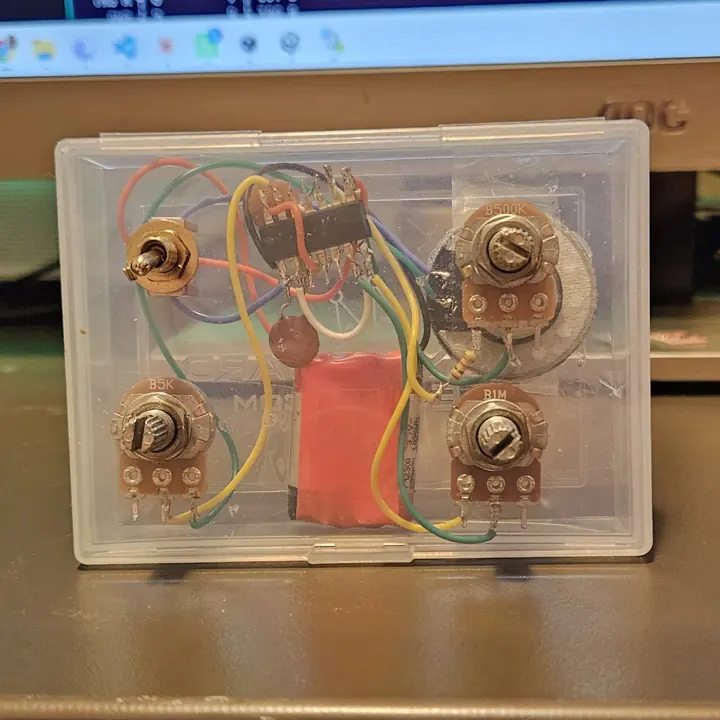
The classic Atari Punk Console - a two-oscillator stepped-tone generator built around a single NE556 dual timer - wired the hard, honest way: dead-bug, point-to-point, no breadboard and no PCB, chip flipped legs-up with every part soldered straight to its pins. The whole thing lives in a translucent Carat card box (the kind playingcarddecks.com throws in with every order), so you can watch the guts while it screams. My first dead-bug build - and, somehow, it fired up on the first try.
- TypeAtari Punk Console (stepped-tone generator)
- HeartNE556 dual 555 timer IC
- BuildDead-bug / point-to-point - no breadboard, no PCB
- ControlsPitch (1M) · Shape (500K) · Volume (10K) · on/off
- OutputSpeaker salvaged from a toy - onboard, no amp
- PowerRechargeable pack salvaged from dead disposable vapes
- HousingRepurposed Carat playing-card box
- MilestoneFirst dead-bug build
- StatusWorking - finished July 2026
What it is
The Atari Punk Console (originally Forrest Mims' “Stepped Tone Generator,” later christened the APC) is one of the great first noise-box circuits. The NE556 is just two 555 timers in one chip: the first runs free as an oscillator, and its output triggers the second, which fires a one-shot pulse for each cycle. Because a fast oscillator keeps re-triggering a slower one-shot, you don't get a clean tone - you get that gnarly, gated, stepped square-wave squawk the circuit is famous for.
There's no board in here. The chip is glued dead-bug - belly-up, legs in the air - and every resistor, cap, and wire is soldered directly leg-to-leg, the way point-to-point builds were done before anyone etched a PCB. It's fiddly, it looks like a spider fell in a solder pot, and when it works on the first power-up it feels like getting away with something.
Fitting for a trash-to-treasure circuit, it doesn't run on a store-bought battery either - it's powered by a rechargeable pack I salvaged from two dead disposable vapes, the same lithium-scavenging trick I wrote up in Do You Want to Survive the Vapocalypse?
Controls & play
- Pitch (1M)
- Tunes the first timer's oscillator - the raw frequency, from low burbles up to a piercing whine.
- Shape (500K)
- Sets the one-shot's pulse width - the “stepping” and timbre. Sweep it and the character shifts from thick and chunky to thin and stuttery, dropping out entirely at the extremes (normal - that's the one-shot running out of room).
- Volume (10K)
- Straight output level into the onboard speaker.
- On / Off
- Toggle on the supply. No standby, no fade - it's either quiet or it isn't.
Under the hood
| Core | NE556 dual timer - timer A as an astable oscillator, timer B as a monostable one-shot |
|---|---|
| Pitch | B1M pot setting timer A's frequency |
| Shape | B500K pot setting timer B's pulse width (a narrower range than the usual 1M - punchier, less dead travel) |
| Volume | B10K output divider |
| Timing caps | 0.01 µF ceramics on both timers |
| Output | Speaker pulled from a random toy, fed through an electrolytic coupling cap |
| Power | Rechargeable lithium pack salvaged from two dead disposable vapes, on/off toggle - see the how-to |
| Construction | Dead-bug - chip legs-up, components soldered pin-to-pin, zero circuit board |
| Housing | Translucent Carat deck box from playingcarddecks.com, pots and switch panel-mounted through the lid |
Mods on deck
It works, so naturally it's time to poke at it. Next up, in order of bang-for-buck:
- Next Reactive LED. Tapped off the output so it strobes with the low notes and tracks the Shape knob's brightness - extra fun glowing through a clear box.
- Cap-switch on the toggle. Switch a second timing cap in parallel for a low / high range flip.
- Body contacts. Two bolts wired to a timing node so a fingertip bends the pitch.
- Output jack. A 1/4" out in place of (or alongside) the speaker, to run it into a pedal or amp.
A closer look
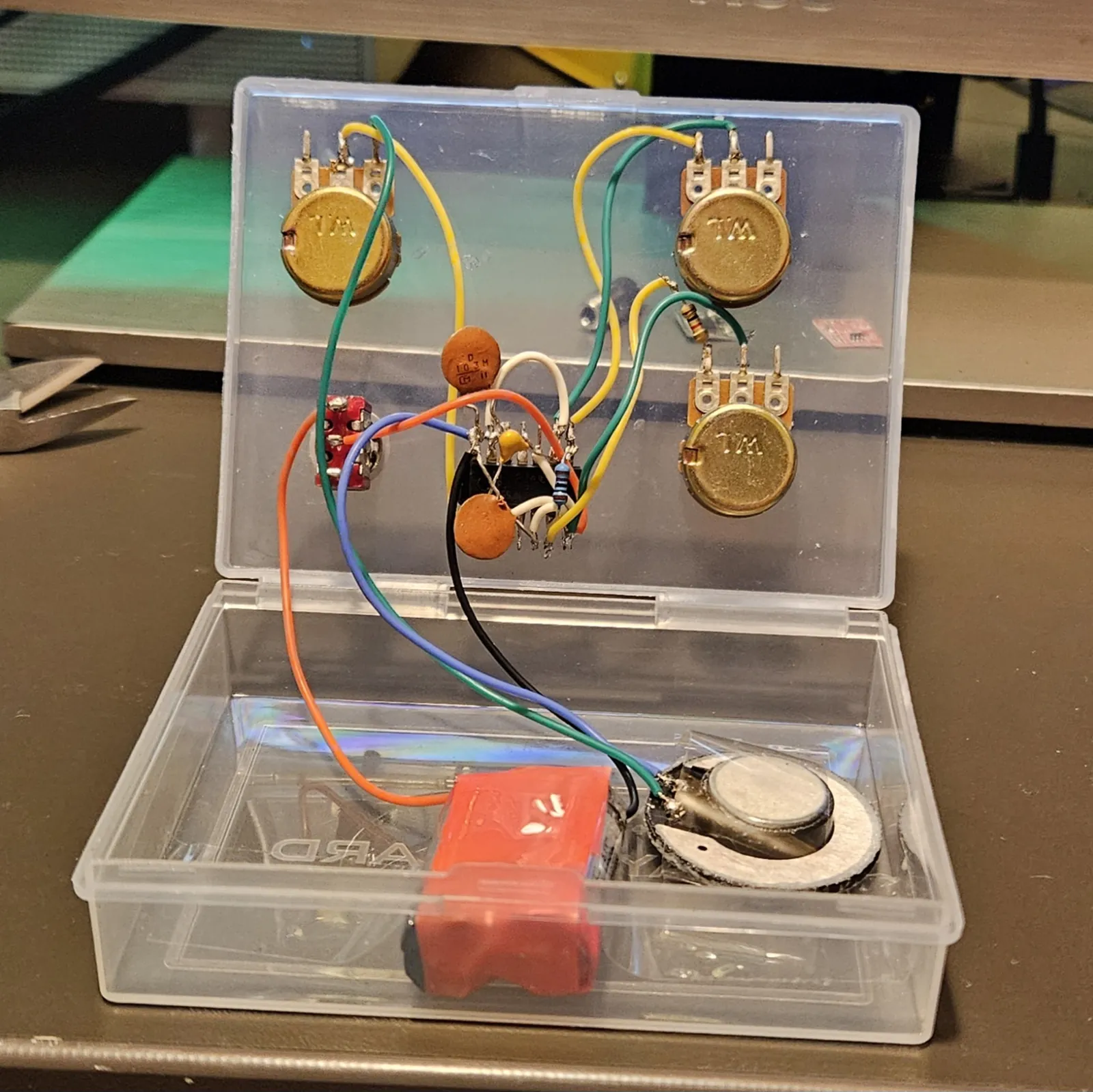
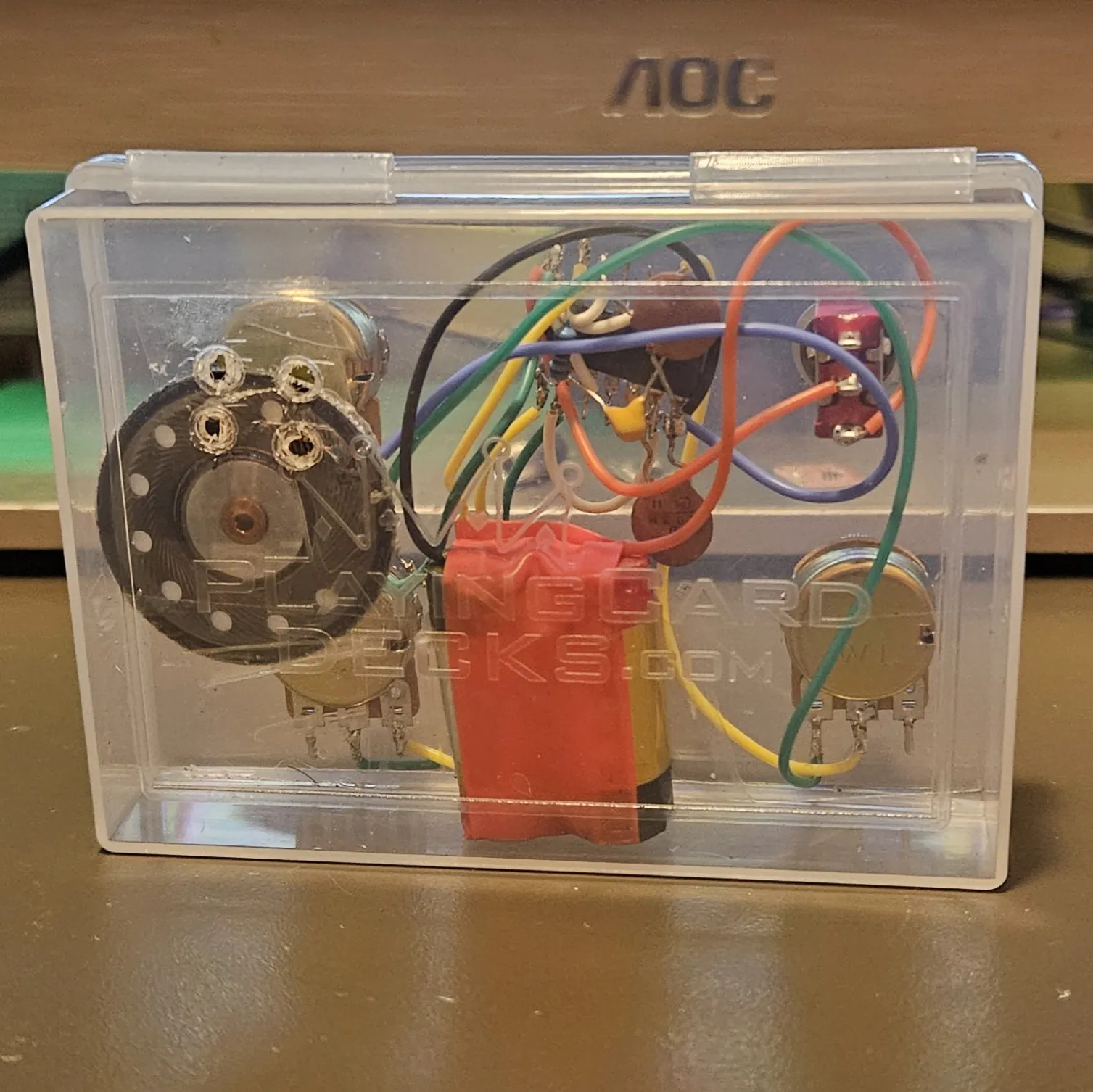
Designed, wired, and boxed by Onion Madder - a one-off dead-bug build. The Atari Punk Console derives from Forrest M. Mims III's “Stepped Tone Generator”; the popular APC name and layout come from the DIY synth community. Card box courtesy of playingcarddecks.com, repurposed with zero permission and no regrets.