Build Log · Added, not bent
Speak n Synth
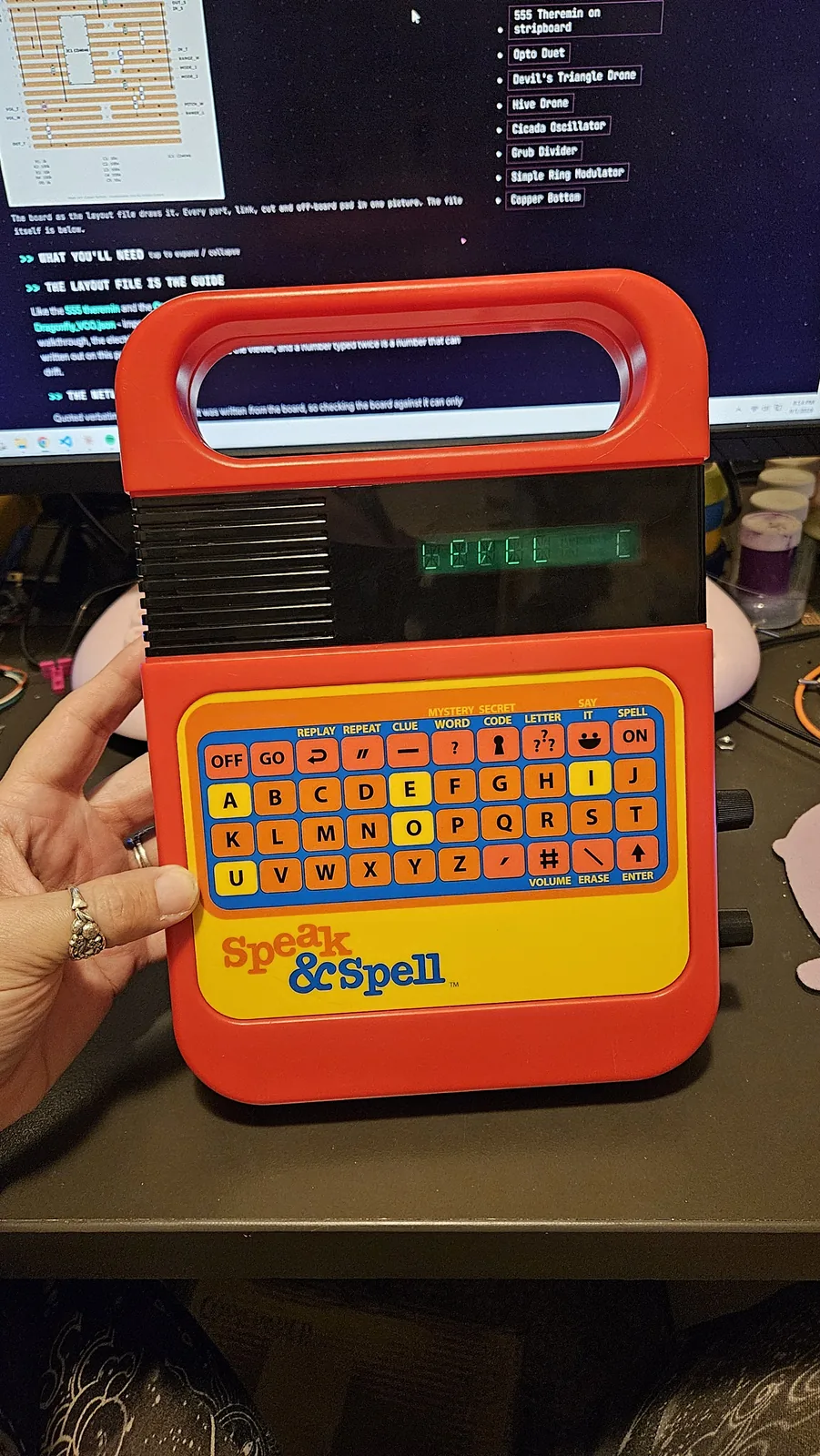
A Speak & Spell with a drone synth and an amplifier built into it. This is not a circuit bend. Nothing was cut and nothing was bridged: the toy's own board is untouched and it still spells, still talks, still plays its games. The drone is a second instrument living in the same case, with its own knobs and switches through the back and its own reason to be there.
- TypeDrone synth and amplifier added to a Speak & Spell (one-off build)
- HostTexas Instruments Speak & Spell, the red one with the handle
- CircuitSynthrotek 4093 Chaos NAND Synth - CD4093 quad NAND
- NotCircuit bent - the original electronics are untouched
- AmpLM386 miniature amplifier with its own volume pot - required, the circuit will not drive a speaker without it
- OutputThe speaker already in the case, shared with the toy through a mini mixer
- ControlsFour knobs and three toggles through the back, labeled CHAOS and DRONE. Pitch, volume and two oscillator variations; on/off and two oscillator gates
- StatusFresh off the bench, Sept 2026 - one of a kind
What it is
Almost everything done to a Speak & Spell is a bend: you go inside, find two points that were never meant to meet, and join them until it does something the designers would not have signed off on. It is a good trick and it is not this one.
It was going to be one. I had the screwdriver out and a plan, and then Bala worked out that I was about to break his toy and got upset about it. He was not wrong about what a bend is. So the plan changed: leave the Speak & Spell completely alone and put a second instrument in beside it. He keeps the toy. I get the noise.
So its board still does what Texas Instruments built it to do, and the display in the photo above is it working normally. What is new sits beside it: a drone synth and an amplifier, added into the empty space in the case, wired to their own controls. It shares nothing electrically with the toy's own board. What the two do share is the case and, at the very end of the chain, the speaker.
The drone is a Synthrotek 4093 Chaos NAND Synth, built around a CD4093 quad NAND gate. That is the same chip as my Cicada NAND, and it is a chip that gets used for this constantly: gate an oscillator with another oscillator and it stops being a tone and starts being weather. Synthrotek describe what comes out as low pulsing drones, random robotic chaos, high-pitched laser sounds, which is where the two words on the tape come from.
The board will not drive a speaker on its own. The LM386 miniature amplifier is not a convenience bolted on afterwards, it is what makes the circuit audible at all, and it brings its own volume pot with it. After the amp, a mini mixer puts the drone into the speaker that was already in the case, so the toy and the synth come out of the same one.
The controls come through the back, which is the only surface with room for them. Four knobs and three toggle switches, with CHAOS and DRONE written on tape above them so you can find them without turning it over and thinking about it. The blue LED comes on with the drone. What each knob does is not a question with a tidy answer, and I am not going to pretend otherwise. It is called Chaos for a reason.
The board offers a fourth switch for CV, so an outside voltage can drive the pitch. I left that one off, which is why there are three toggles here and not four.
Hear it
Demo filmed by Onion Madder on the actual unit.