Sub octave divider · CD4024 · One of a kind
Sub Octave Grub
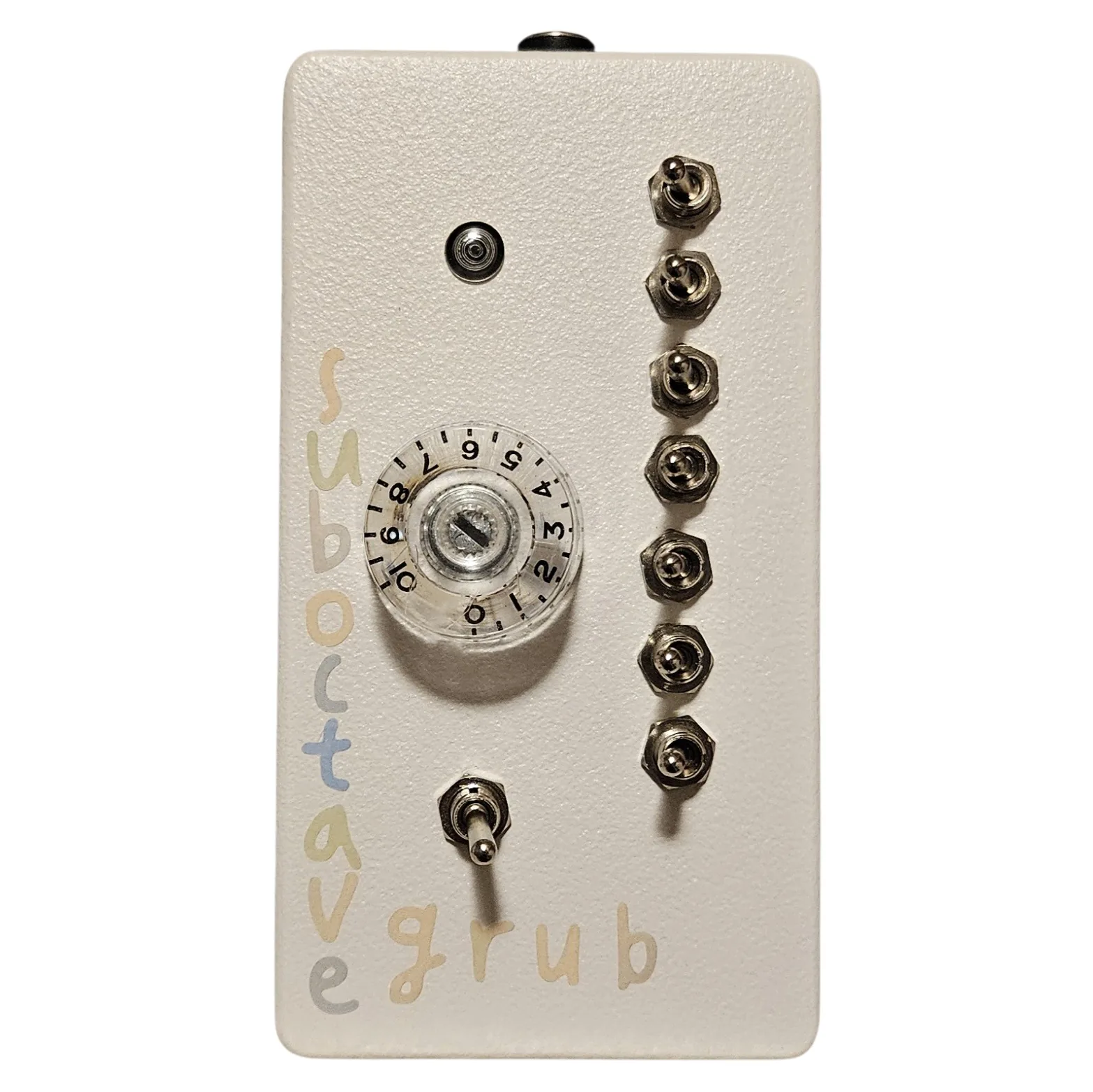
Feed it a signal and it hands you back seven octaves below it, each on its own switch. A CD4024 is seven flip-flops in a chain: the first halves the frequency, the second halves that, and so on down. This box brings all seven out through weighted resistors onto one bus, so you are not picking an octave, you are mixing them - and the weighting means the low ones sit underneath instead of swallowing everything. On my own Grub Divider stripboard layout, boxed upright in white with the name lettered on by hand.
- TypeSeven-octave CD4024 divider, on stripboard
- BoardMy own layout, the free Grub Divider guide
- ControlsSeven toggles, one octave each. One volume knob. One power toggle. One LED
- Input3.5 mm in on the top edge
- Output3.5 mm out on the top edge
- Enclosure125B, stood upright, Tayda textured white, the name hand-lettered on the face
- Power9V DC, barrel jack on the top edge
- BuiltSeptember 2026
- StatusOne of a kind. When it is gone it is gone
What it is
A binary counter counts edges. The first flip-flop in the chain changes state on every second edge that arrives, which is a square wave at half the frequency - an octave down. The second halves that again, and so on, so seven outputs are seven exact octaves below whatever you put in. Not an approximation, and not a pitch shifter guessing at a note: division.
What that gives you is a sub-octave machine with a mixing desk on the front. One switch on is a clean octave down. Three on is the original with two floors built under it. All seven on is a stack that goes below what most speakers will reproduce, and you will feel the bottom of it more than hear it. It wants something with a strong edge going in - a square wave, a synth, a fuzz - because a counter needs edges to count.
The controls
The seven toggles down the right are the seven octaves, one each. Flick one up and that octave joins the mix; flick it down and it leaves. The knob in the middle is volume. The toggle at the bottom left is power, and the LED above it comes on with it.
The box
A 125B stood on end in Tayda's textured white. Sub octave runs down the left edge in pastel cream, blue and gray, and grub sits across the bottom, all of it lettered by hand. In, power and out are on the top edge rather than the face, lettered on the box, so the cables leave upward and it can stand right up against its neighbors. The same upright format as the Dragonfly, the Grub and the Devil's Triangle.
Demo
Demo video coming soon - it's on the bench being filmed.
Or build it yourself
The layout, the parts list and the netlist are the free Grub Divider guide, with the file you can open in Copper Bottom. The guide has two drill templates for this upright box, one with the jacks on the face and one with them on the top edge like this one.