Four boards in one tin · CD4093 + CD4046 + PT2399 · One of a kind
Noise Loaf
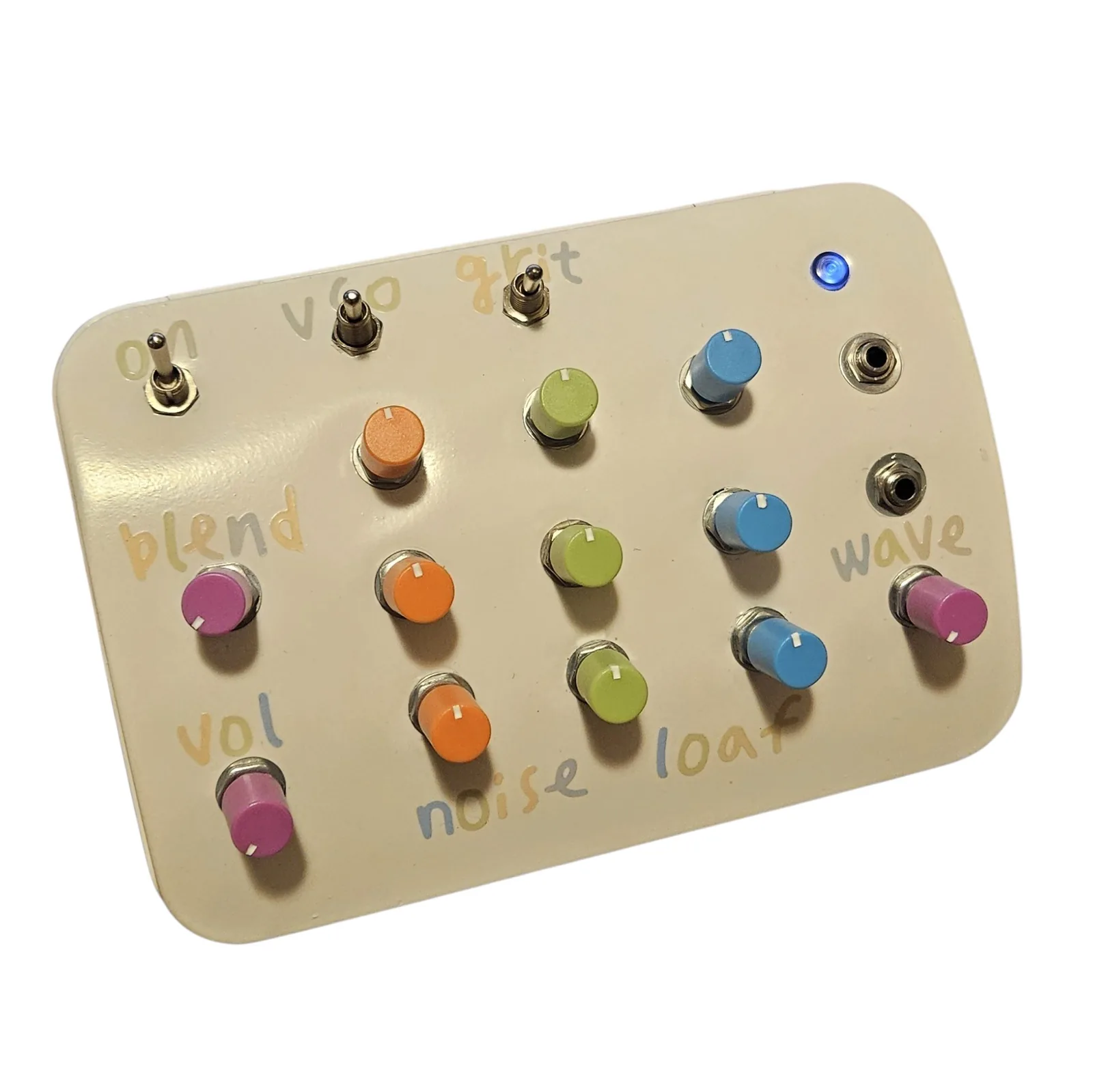
A loaf tin with four noise boards in it. Three of them are my own stripboard layouts, the ones I give away free on this site: the Cicada NAND, a CD4093 running four oscillators that you switch in and out; the Dragonfly VCO, a CD4046 whose second mode is a phase-locked loop that chases whatever it hears; and the Hornet Amp, an LM386 driving a speaker behind the grille in the base. The fourth is a PT2399 delay with a 100K knob on its input, so you can drive the echo from clean into dirt. It plays out loud on its own, with nothing plugged in.
- TypeFour-board noise box with its own speaker
- BoardsMy Cicada NAND, Dragonfly VCO and Hornet Amp layouts, plus a bought PT2399 delay module
- ControlsTwelve knobs and three toggles, lettered on, vco and grit. One LED
- SpeakerInside, behind a hand-drilled diamond grille in the base
- Input3.5 mm line in on the lid
- Output3.5 mm line out on the lid. The speaker keeps playing with a lead in
- EnclosureA steel loaf tin, painted cream inside and out, lettered by hand
- Power12V DC, center positive, barrel jack on the side wall
- BuiltSeptember 2026
- StatusOne of a kind. When it is gone it is gone
What is in it
The Cicada NAND is a CD4093 quad Schmitt NAND wired as four separate square-wave oscillators. Their timing caps are deliberately spread, so one is shrill, one is a mid tone, one sits under that, and the slowest is less a note than a ticking. They sum onto one bus, so you are mixing them rather than choosing between them.
The Dragonfly VCO is a CD4046, which is not really an oscillator chip at all - it is a phase-locked loop, and its second mode is a hunting mode: give it a signal and it tries to lock onto it. Point it at four oscillators at once and it cannot, so it chases, catches something, slips off it and goes again.
The PT2399 delay is a bought module rather than one of mine, because my own delay layout would not fit in the tin. It has a 100K pot on its input, which is the interesting part: turned down the repeats stay clean, turned up they arrive progressively more broken.
The Hornet Amp is the reason it makes a noise at all. It is an LM386 on my own stripboard layout at full gain, wired to a speaker sitting behind the drilled grille in the bottom of the tin.
The controls, and what I will not pretend to know
Three of the twelve knobs are lettered on the box - blend, vol and wave - and the three toggles are on, vco and grit. The other nine are not labeled, and I am not going to invent a map for them.
That is the same answer the Garden Variety gives, and for the same reason: with four boards feeding each other, a knob that does nothing in one setting is the most important one in another. The honest description is that you turn things until it does something you like, and then you cannot get back there. If that sounds like a fault, this is not the box for you.
The box
A steel loaf tin, painted cream, which is where the name comes from. The lid carries all twelve knobs, the three toggles, the LED and both jacks; the 12V barrel jack is on one long side wall, out of the way; the speaker grille is drilled into the base by hand as a diamond, twenty-five holes, seven across at the widest row - the same pattern I use on the Groaner. The knobs are four colors, three of each, which at least gives you something to aim at when you go back for a setting.
It is the second painted tin I have listed, after the Bluebottle. The others in the shop wear whatever artwork the tin came with; these two are painted over.
Demo
Demo video coming soon - it's on the bench being filmed.
Or build the boards yourself
Three of the four are free guides here, each with the layout file, the parts list, the netlist and a drill template: the Cicada NAND, the Dragonfly VCO and the Hornet Amp. All three open in Copper Bottom from the page. If you want the delay on stripboard as well rather than as a module, that is the Katydid Delay - the same PT2399 chip, my own layout, just bigger than the room I had left in this tin.