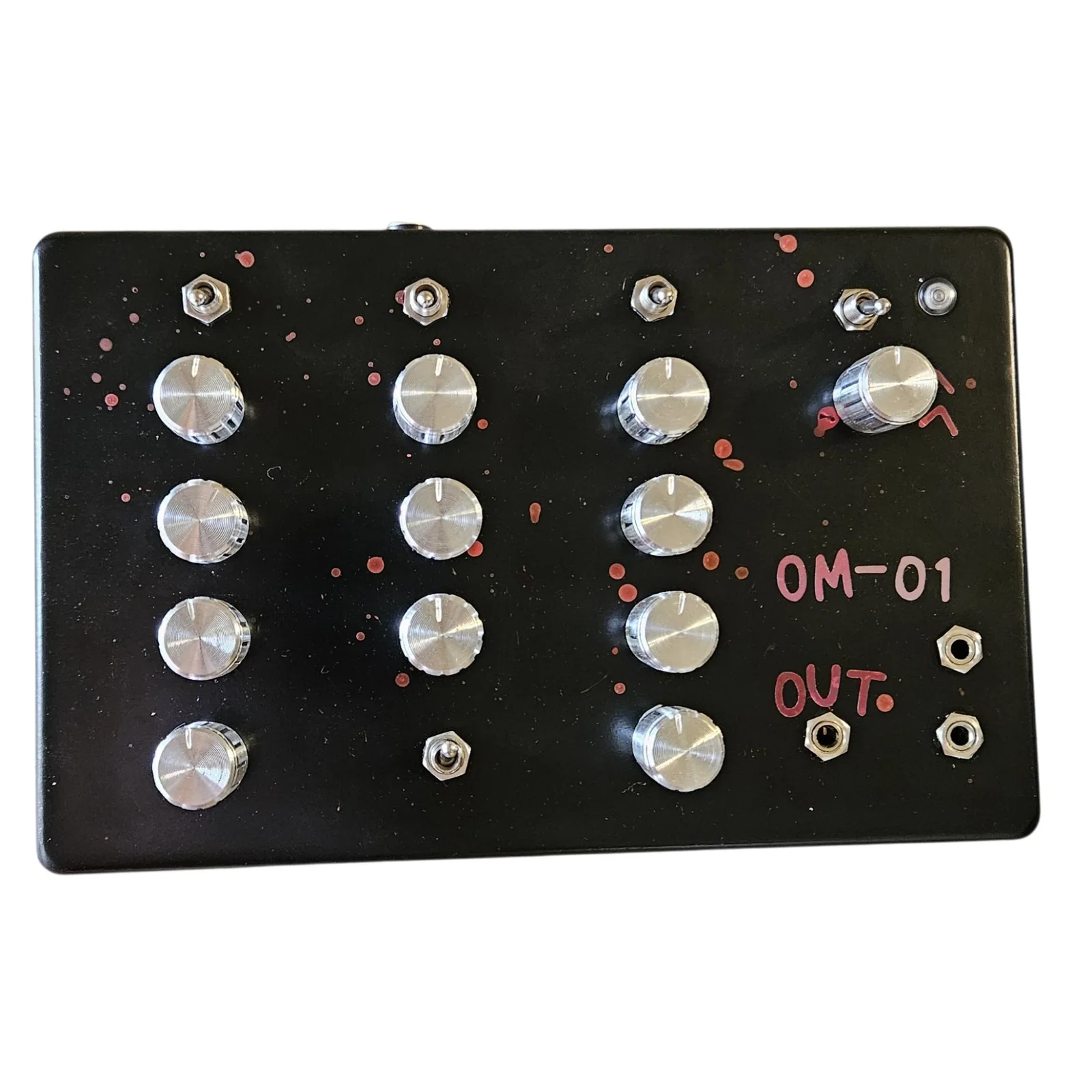
Four boards in one box · CD4093 + CD4046 + two 555s · One of a kind
OM-01
Four of my own boards in one big box, each voice on its own power toggle and all of them summed. The Cicada NAND, a CD4093 running four oscillators. The Dragonfly VCO, a CD4046 that chases whatever you feed the in jack. Two Opto Duets, each a pair of 555s talking to each other through an LED and a photocell. The amplifier on the end does the mixing, and the summed line comes out on the jack marked OUT. Run one voice on its own or pile all four on top of each other. Every layout in it is free on this site.
- TypeNoise synthesizer, four boards in one box
- ControlsTwelve knobs, five toggles (one per voice plus the amp), an indicator LED, and three jacks: summed line out, VCO in, control in
- CircuitMy Cicada NAND and Dragonfly VCO layouts, two of my Opto Duet, into an amplifier that does the mixing
- Enclosure1590DD
- Weight~1 lb 4 oz
- Power12V DC, center-negative, barrel jack on the top edge
- BuiltSeptember 2026
- StatusAvailable - one of a kind
What it does
Three of the four circuits are layouts I drew and give away on this site, so you can see exactly what is in the box before you buy it, and build your own if you would rather. The Cicada NAND is a CD4093 running four square-wave oscillators. The Dragonfly VCO is a CD4046, and its second mode is a phase-locked loop, which means it listens to whatever is going in and tries to follow it. The Opto Duet is a pair of 555s wired through an LED and a photocell shrink-wrapped nose to nose, so one oscillator's output becomes the other's timing resistor. There are two of those in here and I gave each one its own pair of knobs.
The fourth board is the amplifier, and it is the mixer too. All four voices land on it and leave as one line on the out jack, the one with OUT written next to it.
The other two jacks go the other way, into the Dragonfly. The lower one is its signal input, which is what the phase-locked loop listens to, and it works: give it something with a pitch and the VCO follows it. The upper one I added on 23 September, wired straight onto the 4046's pitch node, and it is there so the VCO can be played by something else. I have driven it from one of my own Opto Duets and the VCO tracks it. What I have not managed yet is to play it from a step sequencer, so I am not going to tell you it takes control voltage until I have done it. The wiring is there for it and the jack is on the face; the proof is not in yet.
Every voice has its own power toggle, which is the part worth knowing. You can run one board on its own and hear exactly what it does, or switch all four in and let them sit on top of each other. Four separate things sharing an enclosure is not the same instrument as four things wired permanently together.
The jacks are lettered now but the knobs are not, and I am not going to pretend there is a tidy map. Twelve knobs, five toggles and an indicator lamp. What any one knob does depends on which voices are switched in and where the rest are sitting, which is the reason for putting four of these in one box.
One of a kind. When it is gone it is gone.
Demo
Demo video coming soon.
Controls
- One power toggle per voice
- Four of the five toggles. Each one switches its own board in or out, so you can play a single voice clean or stack all four. That is the thing this box does that a fixed four-board build does not.
- Cicada NAND, four knobs
- A CD4093 running four square-wave oscillators. One knob per voice, and the knob is that voice's pitch.
- Dragonfly VCO, three knobs
- A CD4046. Pitch, range and volume. Feed the in jack and its phase-locked loop chases what it hears, so it will track another oscillator or anything else with a pitch in it.
- Opto Duet x2, two knobs each
- Two of them in here, with a pair of knobs apiece. Those knobs are mine and are not on the drawing I published, so treat them as part of this box rather than part of that layout.
- The amp, one knob and a toggle
- It is the mixer as well. All four voices land on it, it sums them, and the result leaves on the line out.
- Three jacks, and only one is lettered
- OUT is written on the face and is the summed line out. Of the other two, the lower one is the VCO's signal input and the upper one is the control input, wired straight onto the 4046's pitch node. Worth writing down, because nothing on the box says so.
Circuit: my own stripboard layouts, free on this site. Built, painted, and finished by Onion Madder as an original one-off - not affiliated with, endorsed by, or a clone of any commercial brand.