Optical theremin · Two 555s · One of a kind
Solo Duet
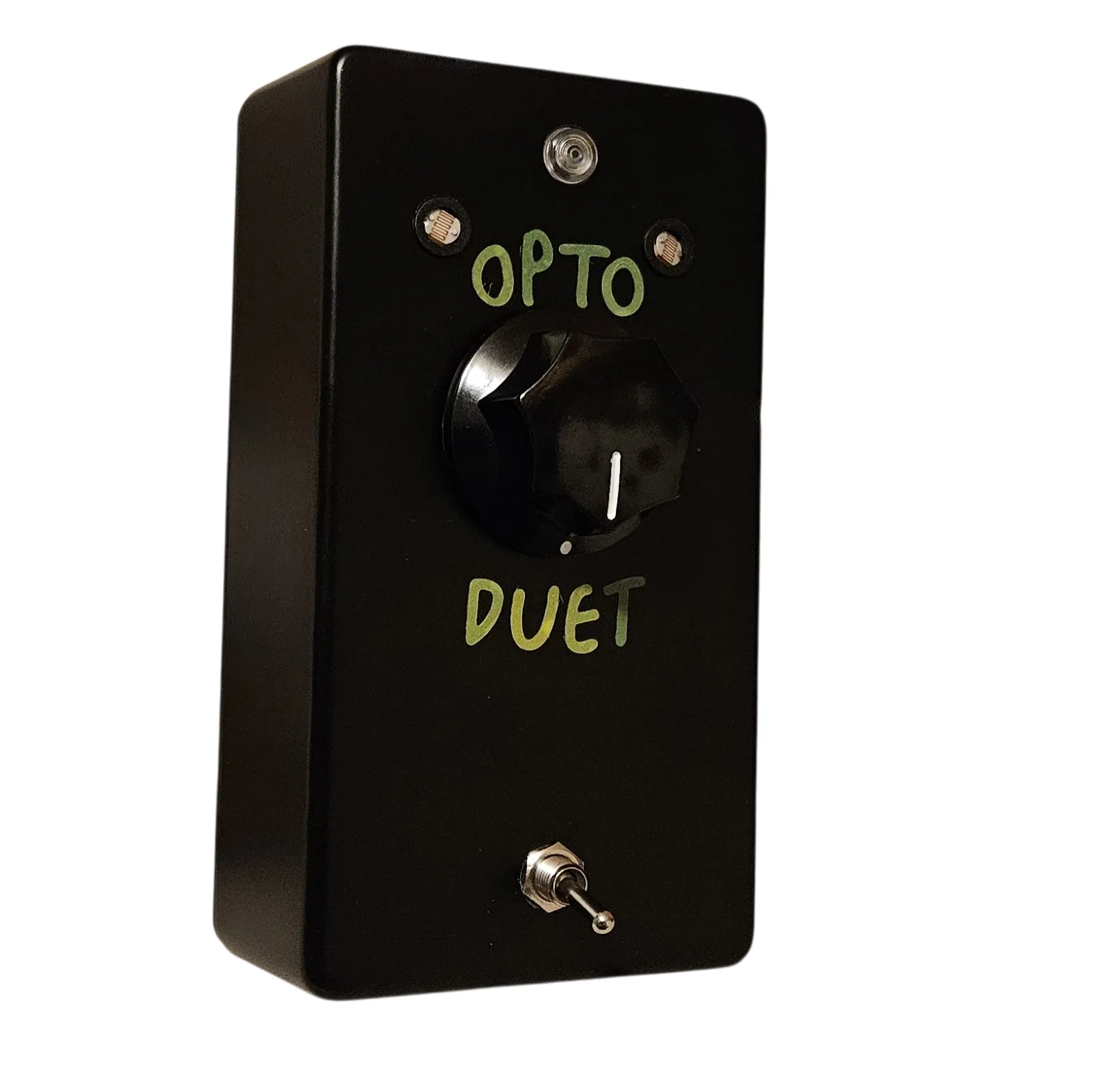
Every other box I make ends at a jack. This one does not. There is a speaker behind the back plate and a battery inside, so the whole instrument is the thing in your hand: flick the toggle and wave at it. Underneath it is my Opto Duet - two 555 oscillators on one board that never touch electrically, only by light. One runs slow and flashes an LED sealed against a photocell; the other one hears that flashing as a change in its own pitch. The two round windows on the face are the eyes that let the room in.
- TypeTwo-oscillator optical theremin, on stripboard
- BoardMy own two-555 layout, the free Opto Duet guide
- ControlsOne pitch knob. One power toggle. One LED
- SensorsTwo photocells on the face, either side of the lettering
- OutputInternal speaker only. There is no output jack
- Enclosure125B, stood upright, black, OPTO DUET hand-lettered on the face
- Power9V battery inside. No DC jack
- BuiltSeptember 2026
- StatusOne of a kind. When it is gone it is gone
What it is
Two 555 timers on one piece of stripboard, and the only thing that passes between them is light. The first one runs slowly and drives a bare LED. That LED is sealed face to face against a photocell, which makes a home-made vactrol: when the LED brightens the cell's resistance drops. That cell is part of the second oscillator's timing, so the slow half keeps nudging the pitch of the fast half without a wire between them.
The two windows on the face are the other half of the story. They are photocells looking out at the room, so what you do with your hands in front of it changes the pitch and the rhythm together. Bright room, dark room, a hand moving across it, a lamp switched on across the room - it all goes in. That is the whole instrument. There is nothing to tune and nothing to plug in.
The controls
The knob in the middle is pitch. The toggle at the bottom is power, and the LED at the top comes on with it. That is all of them. Everything else you get out of it, you get with your hands and the light in the room.
There is no jack, and that is on purpose
Say it plainly, because it is the kind of thing you should know before you buy and not after: this box has no output jack. It plays through its own speaker, and there is no way to take a line out of it without opening it up and adding one. If you want to record it, you record it with a microphone, the way you would record anything else that makes a noise in a room.
There is no DC jack either. It runs on a 9V battery in the box, and the back plate comes off with four screws to change it.
About the battery
Worth knowing from my own bench: this circuit wants about 6 volts to keep everything working, which is more than a 555 needs on its own. The tell is that the light goes before the sound does - on a tired battery the LED fades and flickers while the box keeps chirping away quite happily. That is not a fault, it is the battery asking to be changed. Swap the cell and it comes straight back.
The box
A 125B stood on end in black, with OPTO above the knob and DUET below it, both lettered by hand. The two photocells sit either side of the LED at the top, so they are looking straight out at whoever is standing in front of it. The back plate is where the speaker lives: the grille is a ring of holes drilled around a center hole, done by hand rather than punched, and it comes off with four screws if you want to see inside.
Demo
Demo video coming soon - it's on the bench being filmed.
Or build it yourself
The layout, the parts list and the netlist are the free Opto Duet guide, with the file you can open in Copper Bottom and two drill templates for a 125B. The guide's build ends at a speaker jack rather than a sealed box, so this one is that board taken one step further: speaker in, battery in, lid on. There is a one-chip NE556 version too, and a solderless breadboard version if you would rather not solder anything at all.